Horror Story — a page from the story
The Thread Runs Out
This is the story page on which The Seamstress was first killed, written on . It is shown as it was written. There is nothing to choose here.
Horror Story is written for adults. This page contains horror violence. Age suitability.
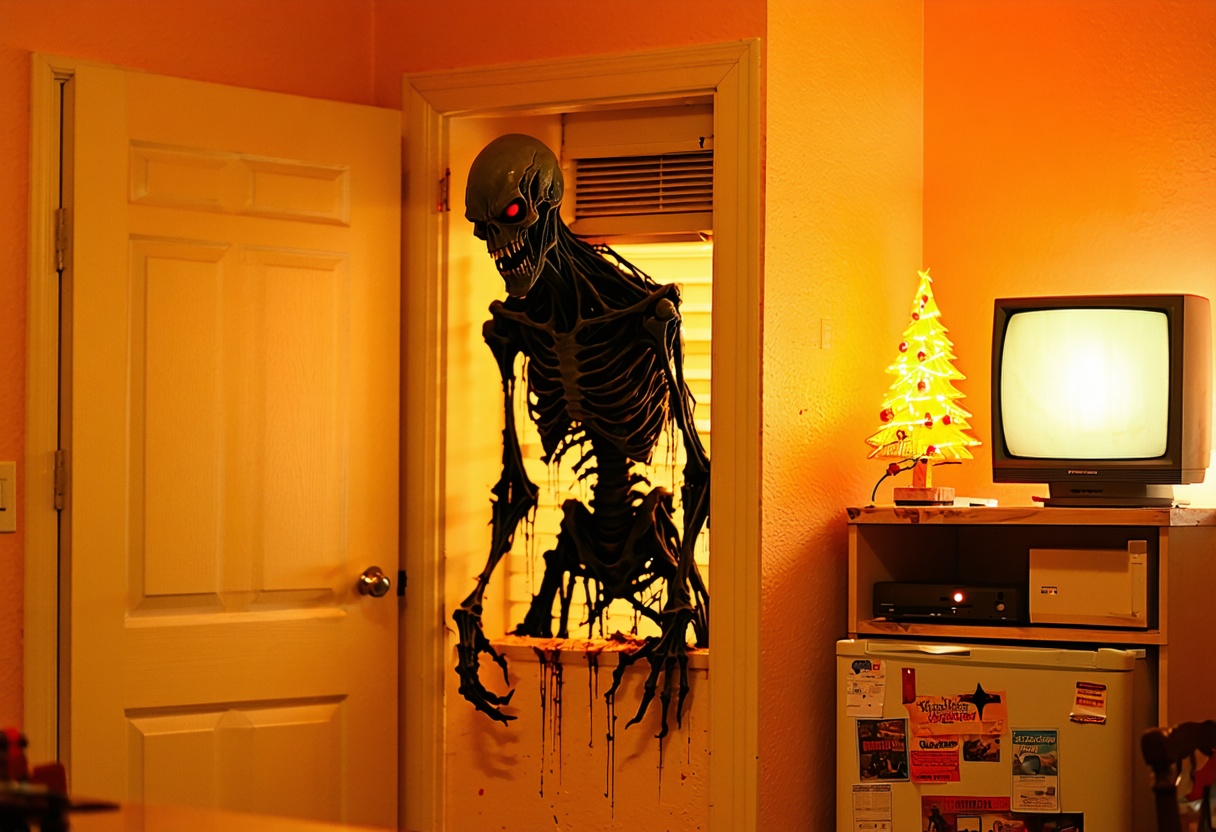
You don't have a plan. You have Marty's blood already cooling under fluorescent light and a vent grille that closed itself like a mouth deciding not to speak again, and that's enough. When the maintenance panel behind the lounge sofa breathes outward — not swings, breathes, the way a chest does before it decides to move — you're already up, already reaching for the fire poker from the cold hearth nobody's used since October, and you go through the gap after it before Drea can finish saying your name.
The crawlspace beyond is narrower than a hallway has any right to be, walled in ductwork and a smell like a sewing kit left in a drawer for forty years — machine oil and old cotton and something underneath both that your body recognizes before your mind does as rot held very, very still. It is waiting for you at the second turn, upright in a space too short to stand in, and for one full second you see it whole: a shape built the way a garment is built, panel by panel, faces — plural, at least four, overlapping at the seams like fabric samples pinned to a board, none of them Marty's but all of them wearing the same wrongness his did, stitched at the corners into expressions that were never meant to move again — one of them young, barely older than a freshman ID photo, its features pinned in place before anyone thought to ask her name. Its hands aren't hands. They're bundles of steel pins fanned like fingers, threaded root to tip with the same amber-dark cord that closed his throat.
It comes at you low and fast, no wasted motion, the patience gone the instant patience stops working, and you don't think, you swing — the poker catches it not in the mass of it but in the throat-seam, the place where two panels of it were drawn together and cinched, the load-bearing stitch holding the whole standing shape upright. Something gives that shouldn't give that easily. The seam doesn't tear. It unthreads, the way Marty's stitches unthreaded off your fingers an hour ago, one continuous unraveling thread pulling itself loose from a hundred yards of hidden stitching all at once — the same small, domestic sound as before, but running backward now, a zipper undone instead of closed — and the Seamstress comes apart the way a hem comes apart, quietly, completely, without a wound anywhere on it because it was never wounded, only unfastened.
It doesn't fall so much as deflate, panel losing tension against panel, the borrowed faces sliding loose of each other and going slack, gone at last from whatever expression had been pinned to them for God knows how many students, how many years. Thread pools where it stood, amber-dark, already thinning, already going translucent at the edges the way the stitches at Marty's mouth had gone to nothing under your thumb. By the time you're back on your knees in the crawlspace gasping, there's nothing left to point to. No body. No fabric. No pins. Just a poker in your hand with a faint oil-and-cotton smell you'll be finding on your clothes for days, and a clean, ordinary square of duct behind you that has never, as far as anyone could prove, had anything living in it at all.
Drea's flashlight finds you first. She doesn't ask if you're hurt. She asks, voice gone very flat, "Is it gone," and you say yes, and she believes you before you've finished the word, because she can see it in how the air in the room has changed — lighter, less attended-to, like a hand has finally lifted off the back of everyone's neck. Amanda doesn't move for a long moment, staring at the empty panel, and when she finally speaks it's not relief. "It'll come back," she says. "Things like that always come back." Chad, for once, says nothing at all — no theory, no genre footnote, like even his running commentary knows better than to jinx a rerun.